

CAR·GO
This project involves designing a complete vehicle package for a specific area of Rotterdam, focusing on Kralingen. The process begins with researching the local demographics, and mobility context, with the goal of creating a package that remains as compact as possible while still accommodating the needs and preferences of a typical household in the district.
Skills:
Primary and Secondary Research, Photoshop, Illustrator, Solidworks, InDesign
2025
4 weeks
CAR·GO was designed by students: David Zwaga, Floor van Breemen, Rayan Ait Hadj Brahim and Chen Di Li.

We visited the Kralingen neighborhood to conduct primary research, including interviews with local residents to understand the atmosphere and daily rhythms of the area. On-site observations helped identify the dominant modes of transportation and provided insight into how people move through and interact with the neighborhood. Photographs taken during the visit were then used to create a collage, capturing the overall feel of the area.
Primary Research
Research
"It's a nice neighborhood, very peaceful, a lot of young married couples who have kids."
Interviews
- Old couple who moved to Kralingen from Germany
"We have an electric car, there are plenty of charging station around, but we only use the car when it's absolutely needed."
- Women in her late 20s
"We come to park often to run. Greenery is everywhere. It's a nice place to live as a student who attend Erasmus."
- 2 young women jogging in Kralingse Bos
Overall Atmosphere
The area has abundant greenery, and residents actively use the parks for outdoor activities such as kayaking, horse riding, jogging, and more.


Kralingen is a neighborhood with a calm and relaxed atmosphere. Even in busier areas, the streets feel quiet and safe.

Kralingen is a relatively expensive neighborhood with spacious homes. Expensive cars are common, reflecting the area’s high standard of living.


0.64
0.88
0.35
0.48
-
Kralingen: more houses in East and more apartments overall than Rotterdam
-
Cars in Kralingen: more in East than West, and overall more than Rotterdam
Secondary Research & Key Findings

Car Per Household
Housing and Cars

Education
Population Age

-
Education in Kralingen: overall higher than Rotterdam, with more students in the East, possibly due to Erasmus.
-
Young adults in Kralingen: more in East than West, and on average, higher than Rotterdam.
Theoretical
Secondary
Practical

Financial Data
-
The average gross income of households in Kralingen is higher than the Rotterdam average, with East Kralingen being wealthier than West Kralingen.
Bruto Income Comparison
Income (Euros)

Housing Price per Square Meter
-
The housing price per square meter in Kralingen is higher than the average in Rotterdam.

-
In Kralingen East, houses are more expensive than in the West, and overall, Kralingen has higher house values than the Rotterdam average.
Average House Value

Infographic
This infographic gathers the findings from our secondary research and illustrates the correlations identified within the data. It also contains further relevant details and visually aligns with the distinctive atmosphere of Kralingen. Click HERE if you wish to review it.
Scenario Making
Personas Development

Name: Wilbert
Gender: Male
Spouse: Jenny
He used to be an artist and now paints occasionally as a hobby; he lives in a big house Kralingen East with his family, plays golf on weekends at the range above Kralingen Plas.

Name: Jenny
Gender: Female
Spouse: Wilbert
She used to be a professor at Erasmus University and still returns occasionally to give guest lectures. She enjoys walking her dog and attends church with her best friend every Sunday.

Name: Nancy
Gender: Female
Occ: Student
(granddaughter)
She recently began studying at Erasmus University and moved into her grandparents’ house. She plays hockey, enjoys kayaking, and works a part-time job.

This is Goldbert
We developed two detailed scenarios, one representing a typical workday and one illustrating a leisure day to better understand how this family living in Kralingen moves through their daily routines. Each scenario showing when they
Scenario Development


travel, what tasks they complete, and how their hobbies and responsibilities shape their mobility needs. In our leisure day scenario, we explored the challenges of transporting larger recreational items: Nancy’s kayak and her hockey equipment.
Leisure Day
Workday
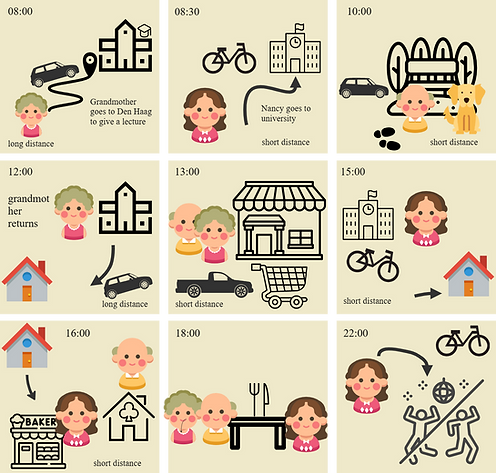


We visualized the family’s daily journeys and estimated the total distance travelled. We also assessed when a larger vehicle is necessary, such as for transporting sports equipment and when a smaller car would be sufficient.
Further Analysis
Design Goal
Design Considerations

Drive at least 30 km on one recharge

Fits weekly groceries and hockey equipment

Seats at least 4

Store a Kayak

Fits in a parking space

Powered by a sustainable source


Accessible to older people and a dog
Cargo Requirements
[


]
[
+

]
[
+

+

]
[
+

]
[
+

+
]

1000 x 400 x 500 mm

2600 x 500 x 300 mm

450 x 180 x 450 mm

1100 x 270 x 270 mm
Designing Inside-Out


Seat Configuration Exploration
Seating configuration studies examined how interior spatial choices could shape the exterior shape. Kayak storage inside the car was explored but rejected due to cleanliness and practicality. Concepts also considered flexible space for the dog that could double as grocery storage.


Seat Configuration User-Testing
To test which configuration provided a comfortable seating position while keeping the car as compact as possible, we sketched the estimated vehicle dimensions on kraft paper. We placed the layout on the floor and also hung it on a wall, allowing us to sit and simulate the seating position and recreate the in-car scenario as realistically as possible.

Driver Seating Position: Ergonomic Dimensions & Key Considerations
Cantrail providing ample headroom
Door sill relatively low to the ground
Minimal height difference between door sill
Ergonomic arm position for steering
Comfortable seating angles for back, knees and ankles
H-point a little lower than hip-height


Vehicle Ingress and Egress Ergonomics
Ingress and Egress: Ensure the least muscle strain when stepping in and out of the car. Try to keep the body in a neutral, stable position, especially for elderly users who may have limited mobility, reduced balance, or joint stiffness.
Designing wider openings, ergonomically appropriate seat height, and supportive grab points can make entering and exiting the vehicle safer and more comfortable.
Kayak Mobility Solutions
Explored concepts for transporting a kayak on a vehicle without disrupting the vehicle’s aerodynamics or overall performance. Consider options that make loading easier for older individuals, and identify mechanisms that could be deployed to support simple, accessible mounting.


