
Adrift
ADRIFT is a stove designed for boat dwellers cooking at the stern, addressing safety risks of open fires in confined spaces. The design prioritizes simplicity, stability, and semi-portability for ease of use.
2024
10 weeks
Designing for UN SDGs
This project focuses on selecting an existing product and redesigning it for a new context to support the UN SDG goals. The BioStove was chosen and developed through a structured process.
What Causes Hunger?
Conflict
Conflict is the main driver, displacing people from their homes and Livelihoods, disrupting markets, and driving up food prices.
Climate Emergencies
Economic Inequality
Floods, droughts and heatwaves destroying lives, livelihoods and crops.
When food prices increase due to weakened economies, farmers face losses and limited access to techonology.
70%
of people facing acute hunger is due to conflict
80%
of hungry people live in disaster-prone areas
20%
of low-income countries are affected by income inequality
Global Impact

of countries experience food insecurity

of households experiece famine

of child deaths are due to hunger

Discovering Opportunities (Group Effort)
Conduct secondary research to identify regions facing food insecurity, limited access to cooking resources, or unique contexts where a BioStove could be beneficial, and explore how the BioStove could help address these challenges.



Brief / Problem Statement
The nomadic community Bajau live in huts on stilts and wooden canoes (Lepa) and sails along the coasts between the Philippines, Indonesia, and Malaysia. The Bajau face poverty and economic marginalisation which undermines proper cooking supplies. They live almost exclusively on food from the ocean, freediving to hunt fish and octopus, and gathering scallops or sea cucumbers while collecting sea urchins at low tide. After gathering the food, they cook over an open fire with a pan or a pot. To design a stove that truly meets the needs of the Bajau people, product autopsy, ethnographic research, participatory design workshops and usability testing will be used.
Context: Understanding the Bajau Community
Nomadic & Maritime Lifestyle
The nomadic Bajau community lives in stilt huts and wooden canoes (Lepa), moving along the coasts of the Philippines, Indonesia, and Malaysia.
Economic Challenges
Poverty and economic marginalisation limit access to reliable cooking equipment, supplies and fuel.
Diet
The Bajau rely heavily on food from the ocean, including fish, octopus, scallops, sea cucumbers, and sea urchins.
Cooking Practices
Traditional cooking may involve open fires, wood, charcoal, pots, and pans. Cooking often takes place within limited spaces, particularly when living on boats or small stilt houses.


Limited Space
The confined sapce of a boat makes it challenging to find comfortable space for cooking
Smoke Explosure
Cooking over an open fire produces smoke that can lead to respiratory issues for those who inhale regularly
Fire Hazard
Wooden boats are highly flammable and an open fire can eaily ignite the structure
Identified Challenges
Project Goal

Utilizes Biomass Burning
Uses readily available biomass as an accessible and practical fuel source.

Enlarged Cooking Area
Maximizes cooking space leaving more room for comfortable movement on the boat.

Tailored for Cooking Seafood
Designed around the Bajau's reliance on fish and seafood for their meals.

Easy Maintenance
Simple to clean and maintain, even within the confined environment of a boat.
"For the Bajau people, the boat serves more than transportation, it is also a space for everyday life, including cooking. However, the confined environment of their wooden boats can make cooking challenging and unsafe. This project explores a more practical and comfortable cooking experience through a stove designed to better support their everyday needs."

Initial Testing of Current Product (Group Effort)

.png)


We tested the BioLite stove in use to understand its ignition, cooking performance, and overall functionality. We then performed a product autopsy to examine its internal components and materials. This helped us understand how its materials and technology work together to enable efficient biomass cooking and energy generation.


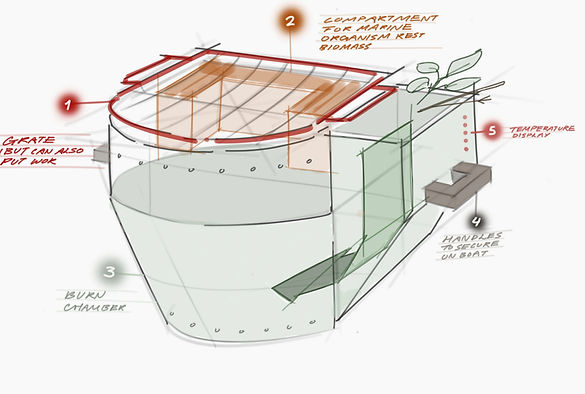
To free up space. How might the stove remain stable when hanging off a boat, and what simple solutions can make it easy to store, carry, and clean?
Ideation


User Testing Setup
The stove is tested on a boat’s stern to simulate real conditions, including movement, limited space, and instability.

Portability

Chute

Stability
Using Testing
User testing highlighted refinements: lower the tunnel edge to reduce burn risk, improve clamp stability, reposition and affordance of the handles, and add a bone-disposal mesh, ash tray, and better placement for the cooling fins, probe, and fan.
Adjusting Screw
Tightening the Clamp
Force Balance at the Rim

Adjusting Screw


Top view

Adjusting Screw
Three-Point Contact System
The problem it solves: a single or two-point clamp can rock or slip on a curved/uneven rim. How the three points work together: the two outer rods hook over the rim and push outwards, while the center adjusting screw pulls the pivot in the opposite direction, so the three forces balance and lock the support in place
Final Physical Model

Use Cycle

1. Start fire: Use flint and steel with dry tinder/materials
2. Turn on fan. Wait for the temperature to rise.
3. Add biomass. Put biomass into the mesh drawer for stronger combustion.

4. Cook on the grill or with a pot/pan.
5. Clean. Rinse and clean the grill after use.
6. Store. Bring the stove inside during extreme temperatures or precipitation.
Design Outcome
Utilizes Biomass Burning
Enlarged Cooking Area
Tailored for Cooking Seafood
Easy Maintenance
Features

Rod Mount Handles
Temperature and Fan Level Display
Fan Control Knob
Provides a sturdy connection between the stove and the support system.
Provides real-time feedback on the current temperature and the fan level.
Allows users to adjust the fan speed, thereby regulating the temperature through the airflow.
The knob is placed on the user-facing side for convenient operation, while the air intake vents are positioned toward the bottom of the stove to enhance airflow efficiency.


Components

