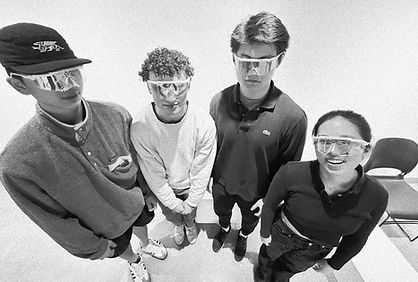
BERC was designed by four Industrial Design students: Bee Kim, Ethan Angus, Richard Pan and Chen Di Li.

The BERC
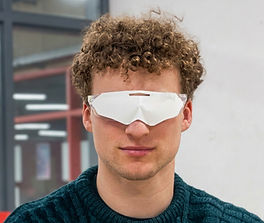
The BERC sunglasses feature an aerodynamic, performance-inspired design that conveys speed and athleticism. A single wraparound lens contours seamlessly around the user's nose, creating a bold, distinctive aesthetic while improving comfort and fit. Designed for the purpose of experimenting plastic prototyping.


Racing Drone Canopy


Inspired by aerodynamic products that enclose components to reduce drag and create a streamlined appearance. Applying this idea, we designed the sunglasses to contour around the nose, giving them a sleek, aerodynamic look. We sketched a variety of concepts to explore and refine different design directions.

Concept Generation


Rapid Prototyping
The most promising concepts were evaluated using paper prototypes. The models were folded to replicate the primary lens curvature and nose contour, allowing us to assess the overall form, fit, and key dimensions before moving into CAD for lazer cutting the lens.


Laser Cutting
An existing pair of sunglasses was also used as a reference to determine the optimal lens curvature. The final design was laser cut from a sheet of PETG.


Mold Making
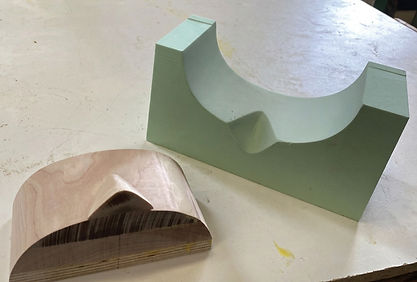
The positive mold was made from wood, cut to shape, and hand-sanded to a smooth finish. A matching negative mold was fabricated from high-density foam, maintaining the required clearance for the PETG lens. The nose piece was shaped separately and assembled after both molds were completed.


Thermoforming
The PETG lenses were heated until pliable, and pressed between the custom molds to thermoform the shape. The process required two heating cycles: the first established the overall lens curvature, while the second refined the nose contour to achieve the final shape.

_edited_edited.jpg)


Film Application and 3D Modeling
A separate PETG film was applied to create the nose contour without heat, reducing air bubbles and improving the final result. Excess material was trimmed and sanded. The frame and temples were modeled in SolidWorks, including custom pin-joint hinges inspired by the Pit Viper screw joint.

Final Design
The BERC, a pair of sport-inspired sunglasses combining an aerodynamic form, wraparound lens, and hands-on plastic prototyping.

Temples
The temples fold behind the lens for a stable folded position, while a subtle hook keeps them secure during movement.

Lens
Depending on the viewing angle and lighting conditions, the lenses shift between shades of orange, purple, pink and yellow.

Hinge
The pin hinge is designed to keep the exterior surface flush when BERC is opened, creating a seamless appearance.
Reflection
"This project was an incredible learning experience for all of us. Through designing and manufacturing the sunglasses, we developed our skills in sketching, SolidWorks, and gained a deeper understanding of plastics, thermoforming, and manufacturing processes. We explored different polymers, including PETG, acrylic, PET, and vinyl films, while learning how their properties influence product design.
The project also introduced us to the use of positive and negative molds, precise mold-making techniques, and the importance of jig design in production. Working with complex shapes helped us further develop our woodworking and prototyping skills, while designing for the human head provided valuable insights into ergonomics and user-centered design. Overall, this project allowed us to explore a new product category, test different solutions, and collaborate to create a refined final design."
- Bee, Ethan, Richard, Chen Di